THE DEVIL IN THE WHITE CITY - Erik Larson
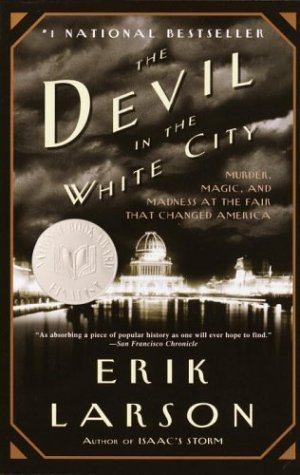
One of the biggest events to take place in the United States in the 19th century, that was not a war, would have to be the 1893 World's Fair in Chicago ( World's Columbian Exposition). Noted non-fiction author Erik Larson takes readers on a deep dive into the machinations behind the event and ties in the workings of one of the world's most noted serial killers after England's notorious Ripper.
The background on the fair is truly fascinating. Larson's research really captures the political maneuverings behind such a massive event, how it would benefit the city (and its politicians), and the struggles to actually make it happen. The number of challenges and disasters was rather staggering to me. What I found most interesting was the work behind the Ferris Wheel - something to rival France's Eiffel Tower - and its own successes and failures.
(A bit of a side note - I learned from my father that my grandmother had gone to this fair and I couldn't help but wonder if she rode on the Ferris Wheel [and before anyone asks, as I write this review, my father is 101 years old].)
This part of the book is interesting, but of course the drama isn't particularly high ("ooh, will the building get built?"), and Larson adds some information about H. H. Holmes, the serial killer who lured women to the hotel he built, complete with special rooms for torture and murder and chutes to dump bodies. He definitely used the Exposition as a ploy to rent out his rooms to women who've come into town to experience the fair. And that's the extent of the tie between the two.
I've read much more interesting books about Holmes and I did not learn anything new here. Larson's research here seems to come from books like Harold Schechter's Depraved: The Definitive True Story of H. H. Holmes, Whose Grotesque Crimes Shattered Turn-of-the-Century Chicago and Rick Geary's The Beast of Chicago: An Account of the Life and Crimes of Herman W. Mudgett, Known to the World as H. H. Holmes.
One of the issues I have with authors like Larson or Bill O'Reilly is giving dialog and/or thoughts on a subject to a historical figure without evidence that they would have said or thought such a thing. For instance, Larson writes:
He had to concentrate to hear the sobs from within. The airtight fittings, the iron walls, and the mineral-wood insulation deadened most of the sound, but he had found with experience that if he listened at the gas pipe, he heard everything much more clearly.
This was the time he most craved. It brought him a period of sexual release that seemed to last for hours, even though in fact the screams and pleading faded rather quickly.
Yeah, this is exciting and tantalizing, but how do we know any of this is true?
I'm not a fan of Larson's work but I read this because it was recommended by someone whose opinion I trust. Unfortunately, my general impressions of Larson's work held true.
Looking for a good book? The Devil in the White City: Murder, Magic, and Madness at the Fair That Changed America by Erik Larson struggles to combine the two different stories of the 1893 Chicago Fair and serial killer H. H. Holmes. The Holmes story is good for book copy but the better story is the work behind the fair.
3 stars
* * * * * *
The Devil in the White City: Murder, Magic, and Madness at the Fair That Changed America
author: Erik Larson
publisher: Crown Publishers
ISBN: 9780609608449
hardcover, 464 pages


Comments
Post a Comment